 Ayashi no Ceres (or AyaCere as it is affectionately known by fans) is a 14-volume manga series created by mangaka Watase Yuu, best known as the creator of Fushigi Yūgi. It was her first long-running series after Fushigi Yūgi finished, serialising in Shōjo Comic (Sho-Comi) like its predecessor from issue #17 in 1996 through issue #4 in 2000. The series won the “shōjo” category of the 43rd Shogakukan Manga Awards in 1998. A 24-epidode anime adaptation was produced by Studio Pierrot in 2000.
Ayashi no Ceres tells the story of Mikage Aya, a popular teenager who enjoys karaoke with her friends and a playful rivalry with her fraternal twin brother, Aki. On their sixteenth birthday, the twins are summoned to their family’s main estate under the guise of a birthday surprise. Instead, they are subjected to a sinister ritual that awakens the power of a tennyo (celestial maiden) within Aya, while Aki is horribly injured. It soon becomes clear that the Mikage family sees Aya not as kin, but as an enemy who must be eliminated to prevent the destruction of the entire clan. Just as Aya believes her life is over, she finds new allies determined to help her escape her fate and blossoming feelings for Tōya, a mysterious man who should be her enemy.
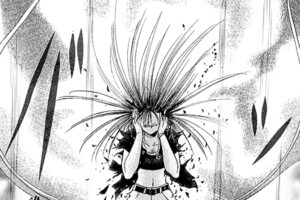

Themes and history
Ayashi no Ceres is a modern suspense story built around a core that draws heavily from psychic battle manga of the past. The series frequently contrasts Aya on the run or investigating aspects of her family’s sordid past with psychic battle arcs that allow Watase to blend high-octane action with supernatural elements through a specifically science fiction lens, punctuated by an undercurrent of horror. This lets the series explore anxieties surrounding humanity and its future that were particularly prevalent at the dawn of the 21st century in a heart-racing manner, with AyaCere particularly focusing on new technology, unchecked power and the consequences of past actions.
Aya must navigate a world thrown out of balance by power-hungry men and those who support their ambitions, all while trying not to lose her sense of self. But she’s ultimately still a teenager, with ordinary dreams of falling in love and finding some sense of security even as her world crumbles around her. This tension between the extraordinary circumstances she faces and the very ordinary desires she continues to hold gives the story much of its emotional weight. Through Aya’s experiences, Ayashi no Ceres examines the importance of human connection and the ways people can find compassion and understanding even in circumstances shaped by violence, exploitation and inherited trauma.

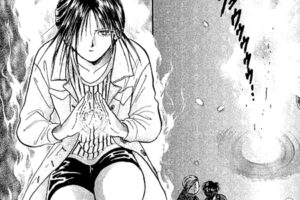
Interestingly, although Ayashi no Ceres was serialised after Fushigi Yūgi in Sho-Comi, Watase had conceived the idea for it long before she came up with her famous story about a teenage girl transported into the world of a mysterious book.
“I thought up this story when I was a senior in high school (here we go again) – even before the idea for Fushigi Yūgi. “Aya” was born then, and had a more occult story, but I’ve changed things around here and there, so I hope there’ll be a different kind of “horror.” – Watase Yuu, Ayashi no Ceres volume #1, author note
Yet, looking back on AyaCere all these years later, it feels like a series that was made for the end of the 20th century. It takes on big ideas about humanity, technology and history and places them against a global backdrop. Watase’s decision to bring the series to life after the huge success of Fushigi Yūgi also feels fitting. Rather than trying to follow it with another broadly appealing story, she seems to have used the opportunity to tell a story shaped by her own hopes and anxieties as the new millennium drew closer.
The result is a compelling story that brings an ancient myth into the modern world in a way that is both familiar and deeply unsettling.
In closing
Ayashi no Ceres may not be as well known as Fushigi Yūgi, and some parts of the series inevitably feel dated or tied to the tropes of its time. However, for readers willing to meet it on its own terms, there is still a lot here that can leave an impression. My hope is that this website can play a tiny part in keeping the series in people’s minds and encouraging new readers to discover it. Times change, but nothing beats discovering a story that sticks with you.